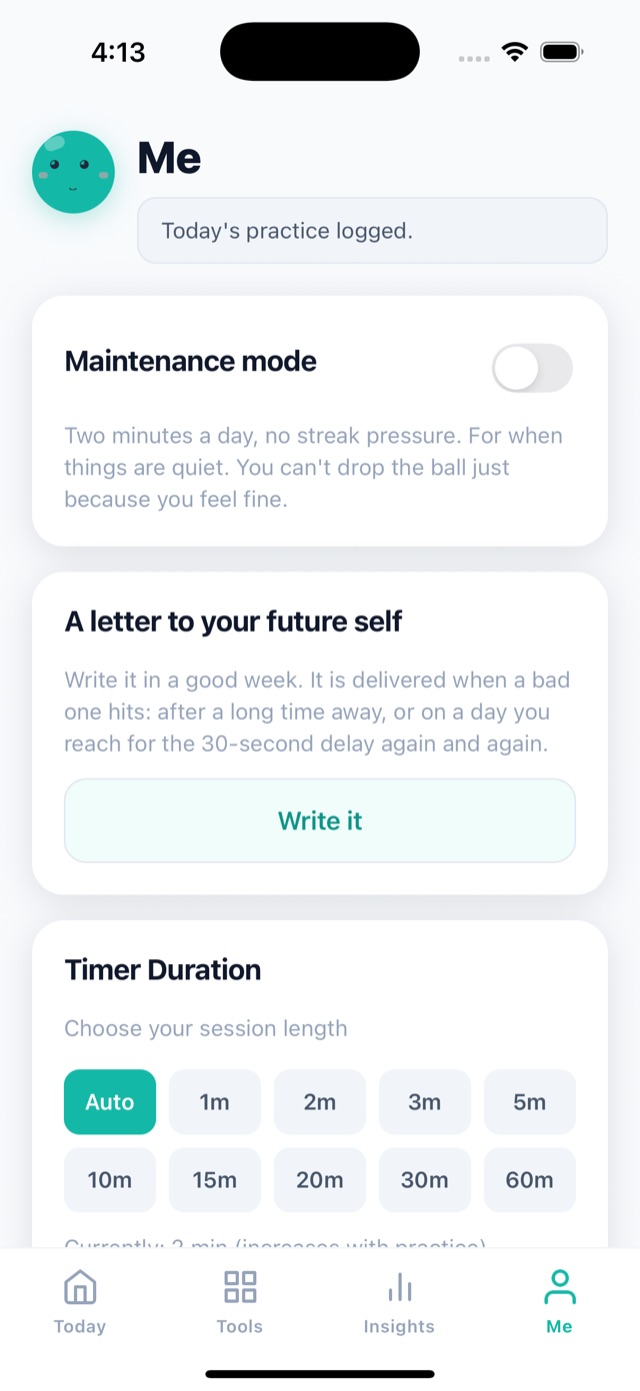
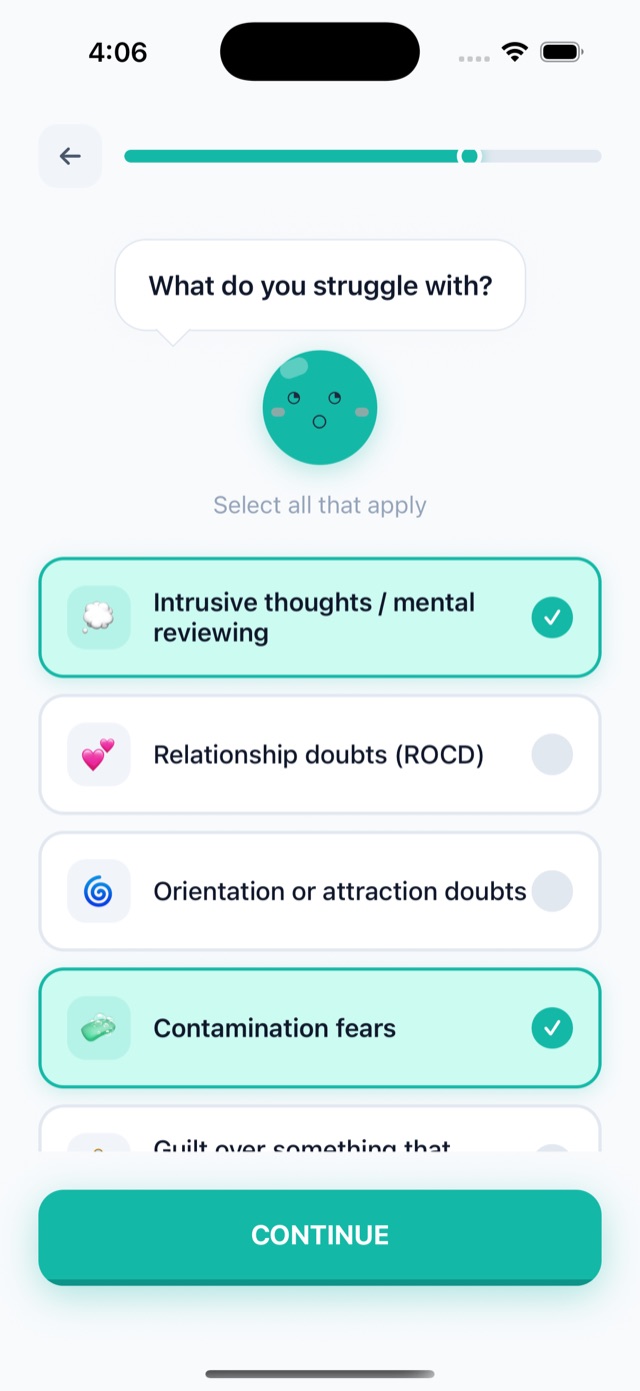
Delay is a small app for practicing response prevention between sessions. Your client starts a timer, lets the urge sit there, and logs what happened. It never answers the question. That's on purpose.
Free for clinicians. You never have to recommend it to anyone.

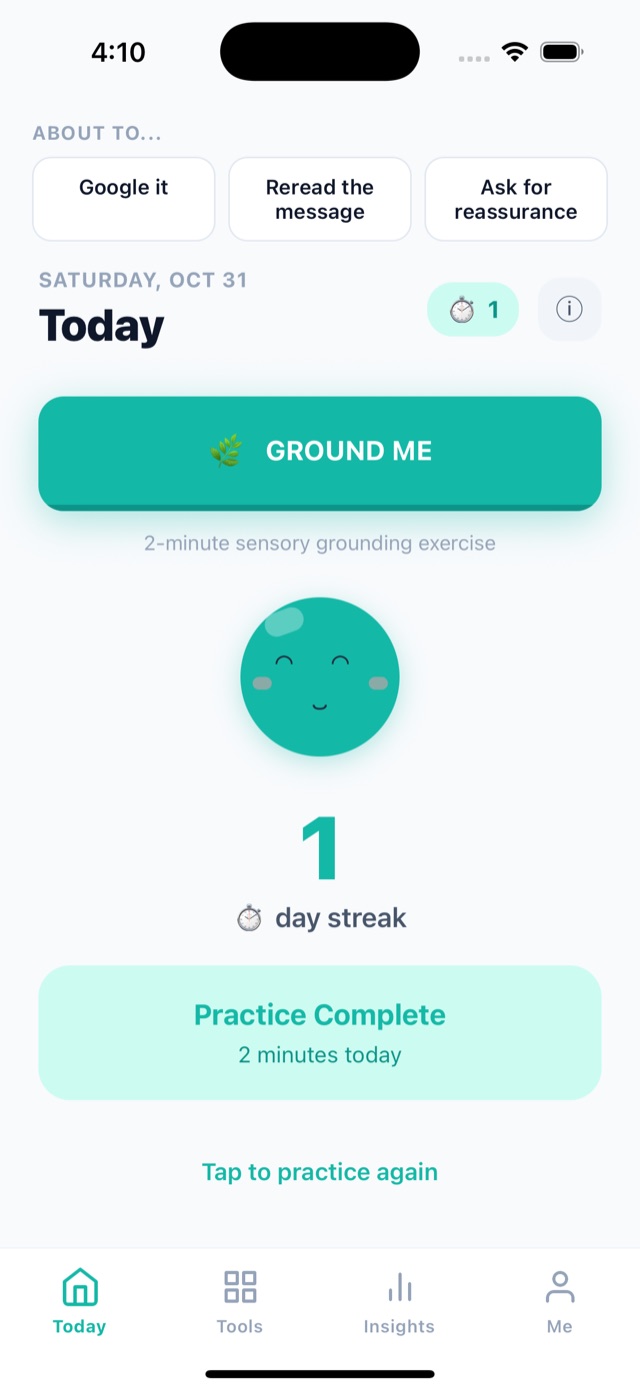
Most response prevention happens when you aren't in the room. These are the moments Delay is built for, shown with the actual screens your client would see.
"Can I just ask you one quick thing?"Reassurance by text, email, Google, or now ChatGPT.
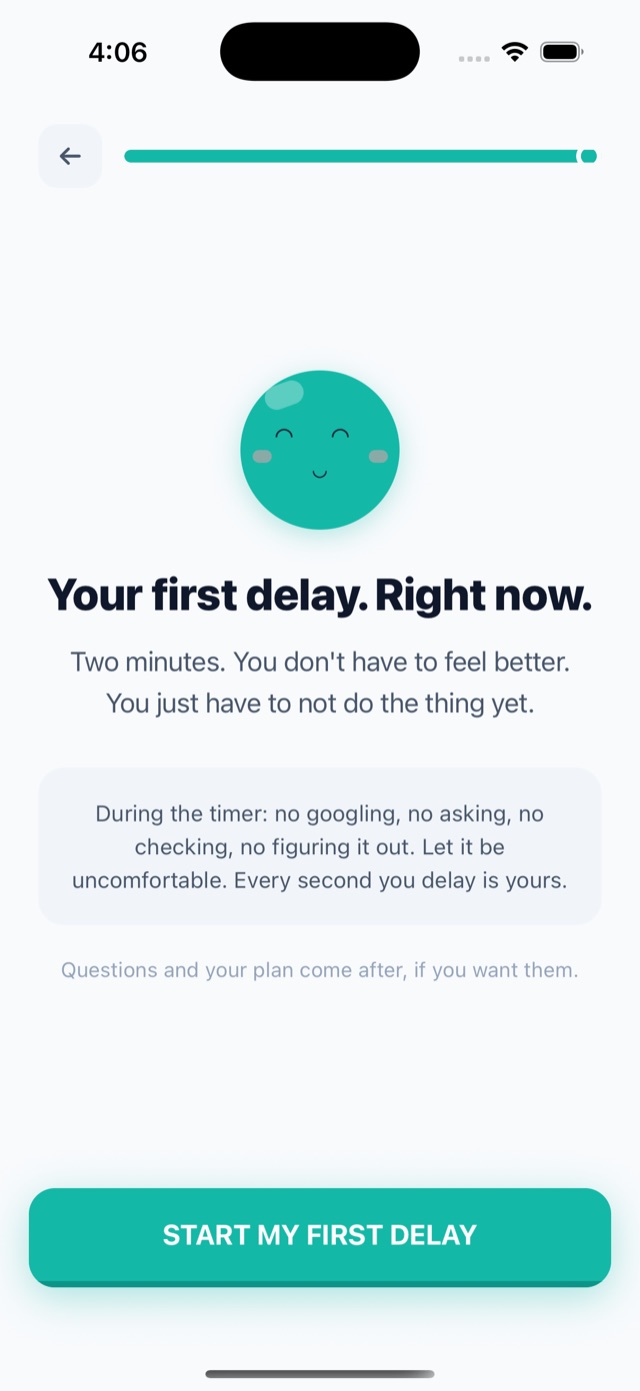
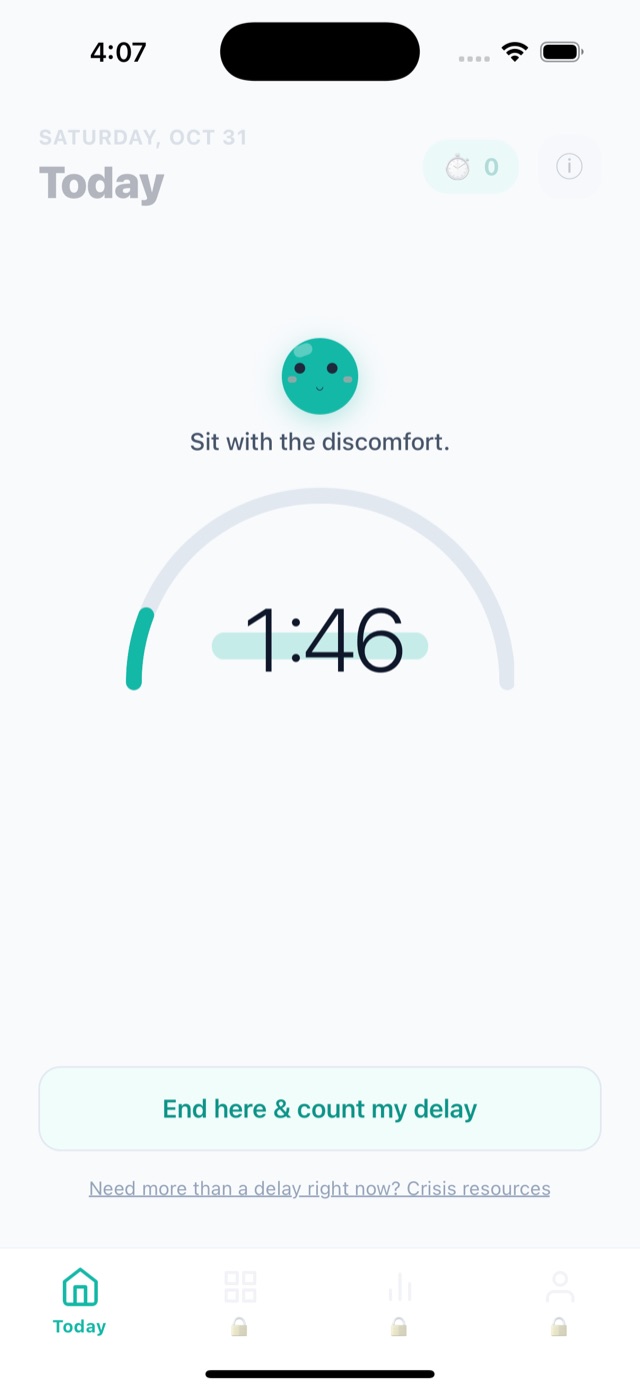
The home screen starts with the urge itself: Google it, reread the message, ask for reassurance. Tapping one starts a delay instead. Nothing on the other side gives an answer.

"It's 1am and the thought won't stop."Nobody to call, and the urge to search is loud.
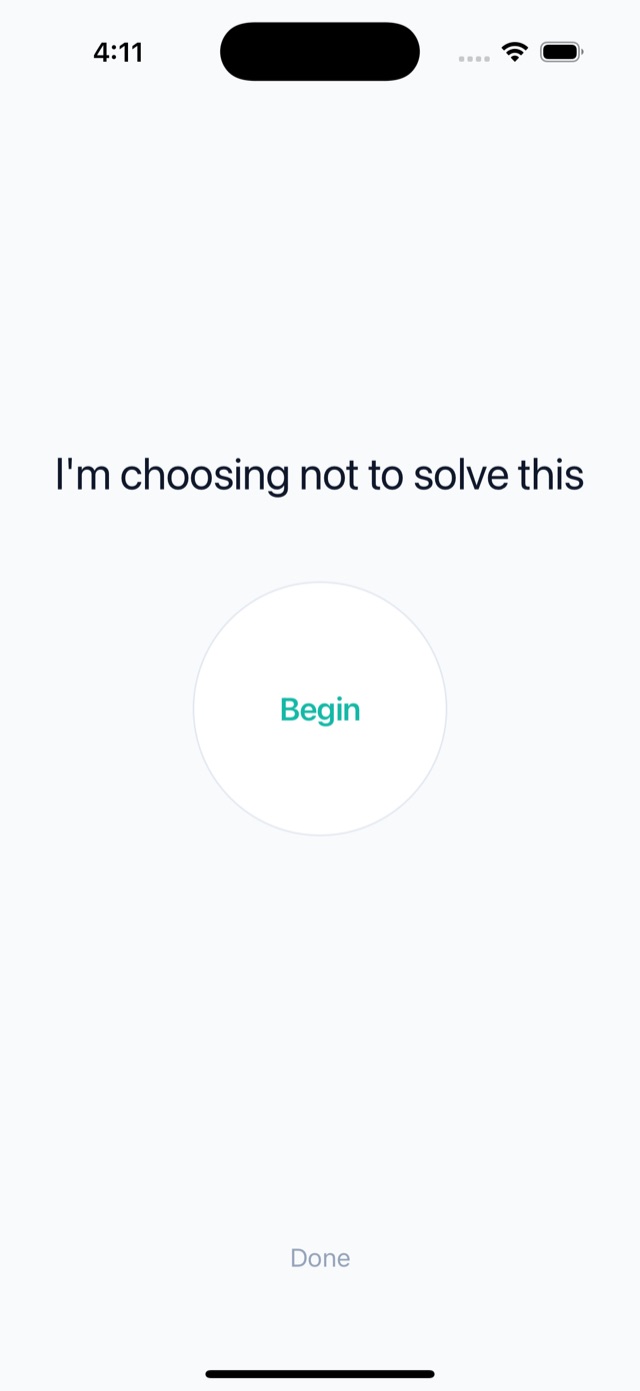
A dim screen with a few slow lines, like "The urgency is false. Nothing needs to happen now." There's no search box and no library on this screen. It's built to be boring enough to put down.

"I did great in session, then nothing all week."Homework that never quite happens.
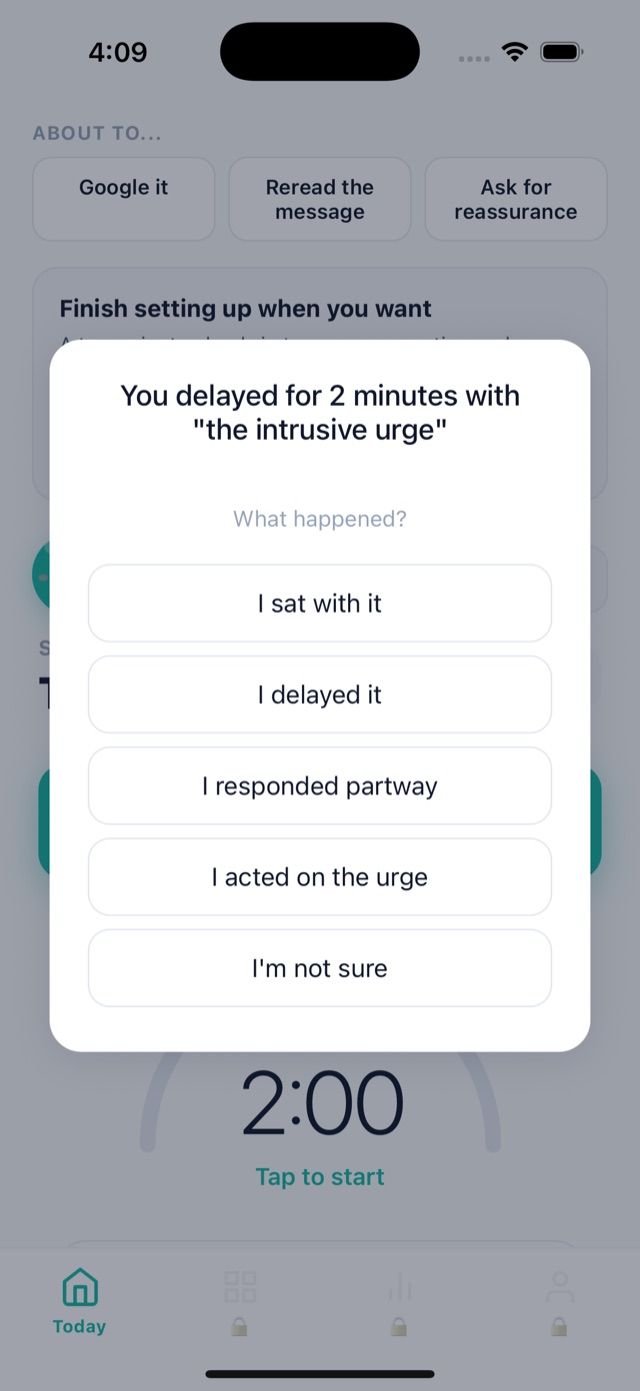
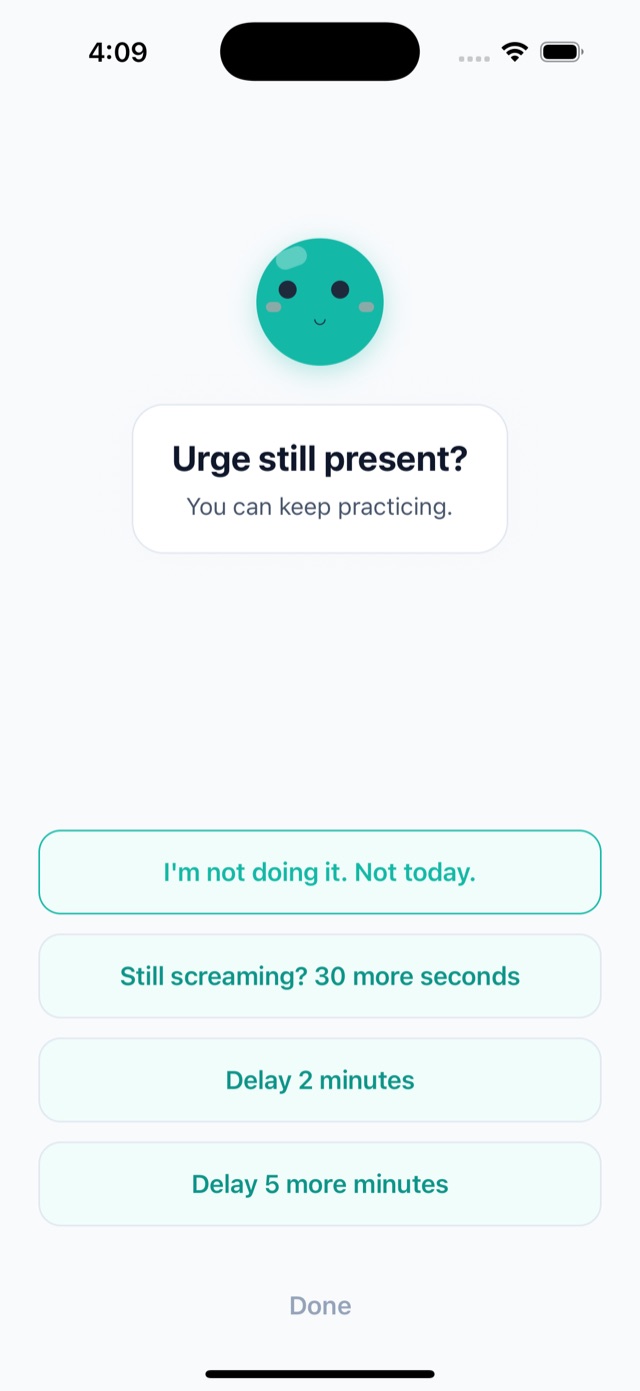
Practice starts at two minutes and grows as they keep showing up. Afterward they pick what happened: sat with it, delayed it, responded partway, acted on it, or not sure. No scores and no shame on any of them.

"I don't even know what I'm trying to get."The compulsion is automatic before it's noticed.
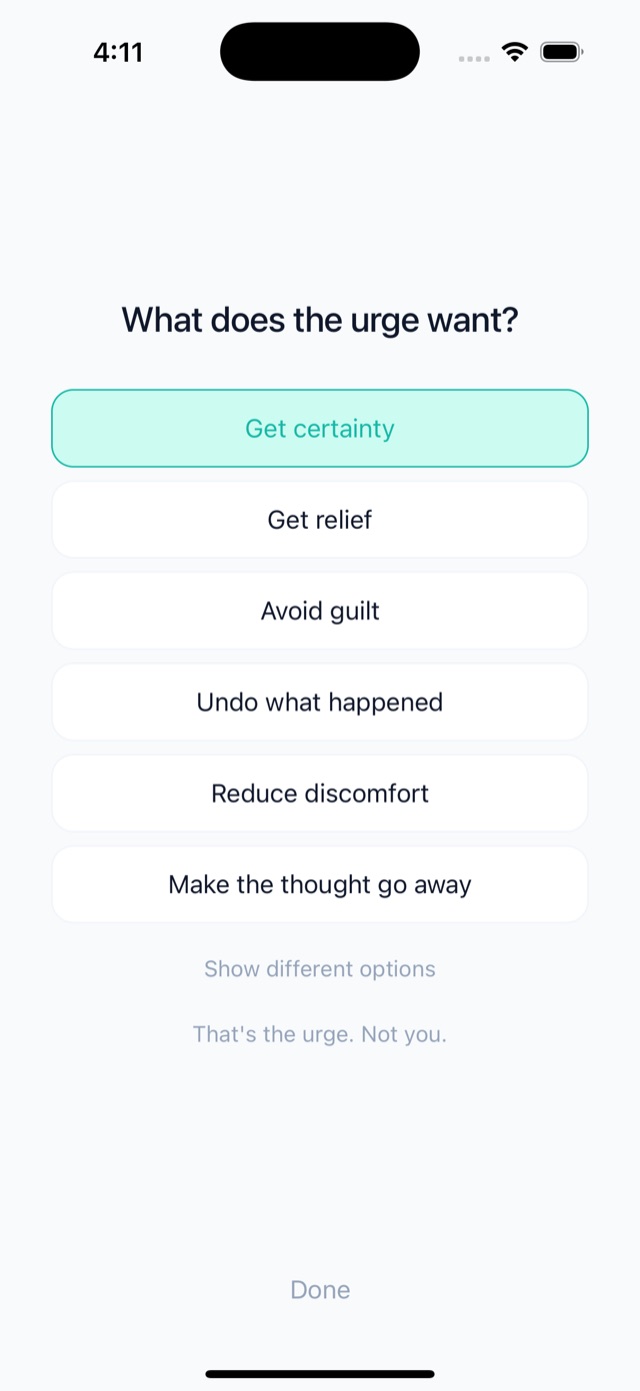
One question: what does the urge want? Certainty, relief, to undo something, to make the thought go away. They tap one and get a single line back: "That's the urge. Not you."

"They avoid the small stuff too."Exposure stalls between sessions.
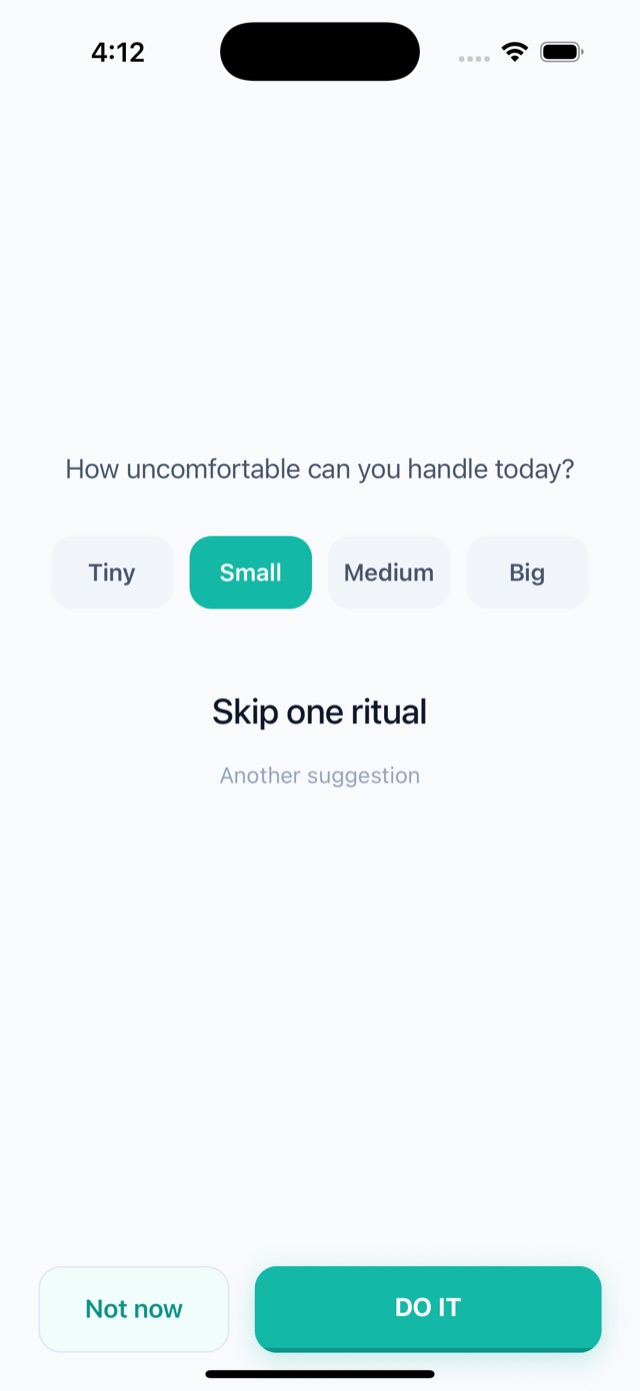
They choose how much discomfort they can take today, from Tiny to Big, and get one concrete step, like "Skip one ritual." Then they can do it, or say not now. You still own the hierarchy.

Spend five minutes with the free access I send you. Open Late Night and the reassurance delay and see if the tone fits how you work.
Print the one-page handout, write in the urge and delay length you want them to practice, and hand it over.
Their log lives on their phone. They scroll it with you in session. No portal, no logins, nothing to monitor.
Nothing here is a mockup. Scroll sideways to see more.


No referral fees, no commissions, no perks for sending clients. Free access is for you to evaluate the app, and that's all it is.
Get free clinician accessResponse prevention, a few minutes at a time, when the urge shows up.
Decide if it fits before any client hears about it.
Two minutes to show a client. The handout does the rest.
No account, no dashboard, no BAA, nothing to monitor.
Try it, tell me what you think, or don't. If it's not for you, reply "not for me" and you won't hear from me again.
You'll get a reply within 48 hours saying what I'm changing, or a straight answer on why I can't.
I won't quote you, list you, or mention your practice anywhere without your written OK.
You know better than any app when a delay fits a given compulsion. Here's an honest picture so you can decide.
Some clients will only resist "with the timer," or use it to earn the compulsion afterward. Maintenance mode and ending a delay early make it easier to fade the app out. The guide covers how.
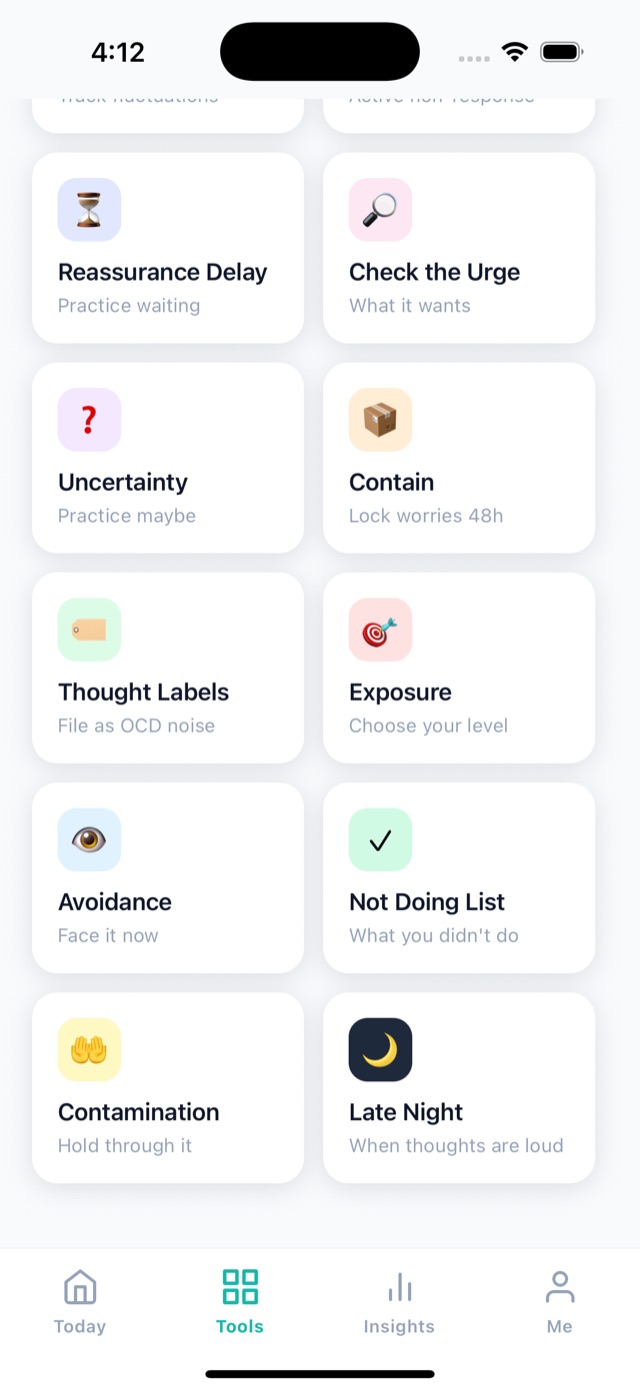
The app has a library of common OCD patterns. For some clients, looking up whether a thought "counts" is its own compulsion. If you see that, tell them to skip it.
Every timer screen links to crisis resources, and the app lists 988 for the US. Delay doesn't assess risk and never tells anyone they're safe.
Delay never asks for a name, email, or phone number.
Worries, labels, screener answers, urge ratings and session lengths are stored on the device and never sent to us.
Since version 1.1.7, Delay collects no usage statistics and uses no ad-tracking tools. If that ever changes, the app will ask first, with it switched off by default.
If a client subscribes, Apple or Google take the payment and RevenueCat manages the subscription under a random ID. Nobody sees their card details.
No data is sold or rented, and there's no data business behind Delay.
HIPAA doesn't apply. Delay is a consumer app, not part of your practice, which is why it collects as little as it does. If a client shows you their log in session, it becomes part of your record the usual way.
Full details are in the privacy policy and the Consumer Health Data Privacy Policy.

"My worst OCD moments were never in a therapist's office. They were late at night, phone in hand, one search away from an answer that wouldn't last."
Max McKenna, maker of Delay
I built Delay for those moments, for myself first. It's a one-person company in Maine, so when you write, you get me. I'm not a clinician, which is exactly why I want ERP specialists to tell me what's wrong with it.
Not on Delay itself. It hasn't been tested in a trial, and I won't claim it works until there's data. It's built on a step ERP clinicians already use: delaying a compulsion, then shortening it, then dropping it. If you'd ever want to look at it more formally, I'd welcome that.
It's free so you can evaluate the app, and nothing is tied to recommending it. There are no referral fees, commissions or perks of any kind. If your licensing board has specific rules on vendor products, those come first.
No. I don't pay referral fees, commissions, or per-client payments, and free clinician access doesn't depend on recommending it to anyone.
No. There's no therapist dashboard and no way for anyone else to see a client's data. They can show you their log on their phone in session, which also keeps them in charge of what they share.
It's designed not to. The timer and Late Night screens never answer the question. The one place to watch is the pattern library, which explains common OCD fears. Some clients may use it to check, and if that happens, have them skip it.
There's a free trial, then $59.99 a year, $9.99 a month or $2.99 a week. A 30-second crisis delay is always free. If cost would keep a client from using it, email me.
There's a tool for holding off a wash or clean. Whether a delay fits a particular compulsion is your call, and the guide has notes on when it doesn't.
Me, Max McKenna. Delay is made by JadeTrade Marketplace LLC, a small company in Appleton, Maine. No investors and no data business.
Next week can look like this one: a good session, then six days on their own with the urge. Or they can have something to open when it hits.
P.S. Only have a minute? Open the handout. It's one page, and it's exactly what a client would see.